
Good, Evil, and the Ease of Betrayal
The Satanic VersesThis thread examines how the novel unsettles fixed moral categories by linking harm to human choices, inherited injury, and the possibility of forgiveness.
increasing Bearing strength in each event
 decreasing
Bearing strength in each eventdecreasingOpposites Joined in the Fall
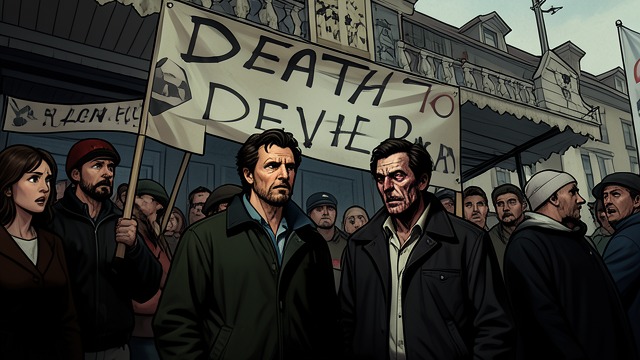
Opposites Joined in the Fall
Two men, one catastrophe
Gibreel Farishta and Saladin Chamcha emerge from the same aircraft disaster with apparently opposed symbolic identities: one is associated with angelic transformation, the other with demonic change. Their shared survival binds the categories together before either man can explain what has happened.
A fragile moral division
The narrator repeatedly questions whether Gibreel is truly a heavenly agent or whether Saladin’s monstrous appearance reveals an inner evil. Their identities shift with dream, illness, fear, and other people’s interpretations rather than holding still as stable moral facts.
The fall makes good and evil an unstable relation between people, not merely opposing substances. Each man becomes, at different moments, the other’s witness, victim, or adversary.
A Deal and Its Reversal
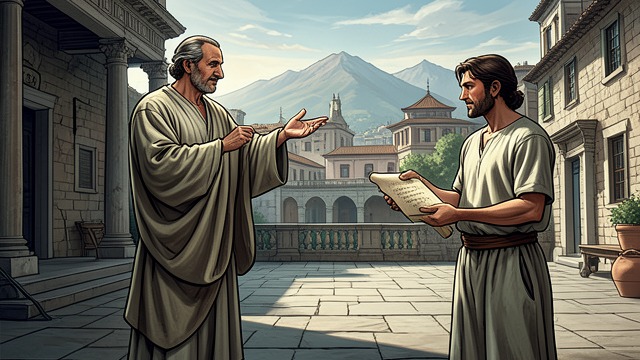
A Deal and Its Reversal
Compromise under pressure
Abu Simbel offers Mahound political recognition in return for a limited acknowledgment of the city’s goddesses. The proposal makes compromise appear capable of ending exclusion, but it also threatens the coherence of the faith Mahound is establishing.
The cost of certainty
The verses that seemingly accept the goddesses are later repudiated as satanic. Mahound’s followers interpret the reversal as a vindication of faith, while the narration’s account keeps the source of both utterances unsettled.
The episode complicates the idea that moral strength consists simply of refusing compromise. Political accommodation may preserve a movement, but religious certainty can also conceal a struggle over power, authorship, and the meanings others must accept.
Hind’s Surrender and Mahound’s Restraint

Hind’s Surrender and Mahound’s Restraint
An enemy at the victor’s mercy
After Mahound returns to Jahilia, Hind submits to his authority, despite their long-standing conflict and her role in the violence against his community. The moment asks whether conquest will bring retaliation or whether a new political order can make room for a former enemy.
Mercy as a political answer
Mahound accepts Hind’s submission, and Abu Simbel’s surrender also prevents the city’s capture from turning into an immediate purge. The restraint is neither sentimental nor free of unease: the people remain subject to a new authority, and the memory of past injuries persists.
The episode returns to the question raised by power itself: what happens when an uncompromising movement wins? Mercy becomes a consequential choice, not proof that the conflict has vanished.
Revenge Made Easy
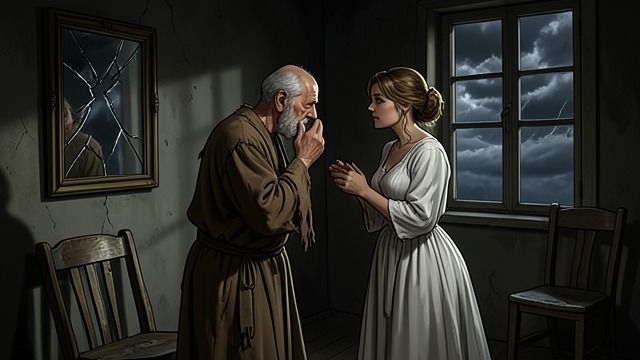
Revenge Made Easy
Injury becomes intention
After feeling betrayed by Gibreel’s failure to help him, Saladin nurtures a desire for revenge. He turns information about Gibreel’s jealousy into a strategy, using manipulated voices and invented intimacies to destabilize Gibreel’s relationship with Alleluia Cone.
The moral choice hidden in manipulation
Saladin understands that his method is cruel but proceeds, telling himself that Gibreel deserves the injury. The narration locates evil not only in catastrophic violence but in the deceptively easy decision to exploit another person’s weakness.
His actions do not make him irredeemably monstrous, but they cannot be dismissed as the product of persecution alone. The novel insists that injury may explain a choice without making it innocent.
Mercy in the Burning Café
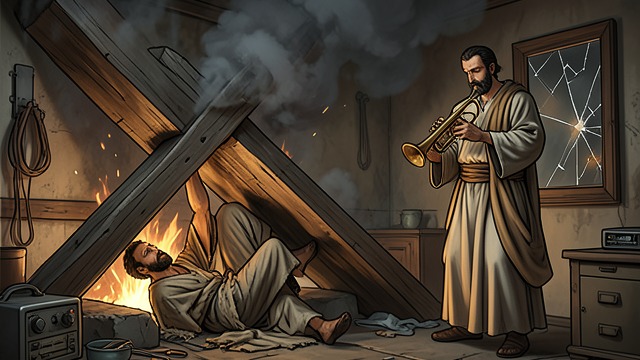
Mercy in the Burning Café
The adversary appears human
When the burning Shaandaar Café brings Gibreel and Saladin face to face, Gibreel recognizes Saladin’s role in the campaign against him. The recognition strips away the simpler idea that evil must arrive from outside a person as an invading supernatural force.
A choice beyond vengeance
Saladin is trapped beneath a fallen beam and cannot save himself. Gibreel has the opportunity to retaliate, but instead drops his trumpet, frees Saladin, and carries him through fire and smoke.
This rescue does not erase Saladin’s betrayal or Gibreel’s suffering. It demonstrates that a person’s capacity for harm need not exhaust the whole of that person, and that mercy can interrupt—without magically undoing—the momentum of revenge.
During Gibreel and Saladin’s descent from the Bostan
From Abu Simbel’s proposal through the repudiation of the verses
During Mahound’s return and conquest of Jahilia
During Saladin’s campaign against Gibreel in London
At the end of the Brickhall fire
